

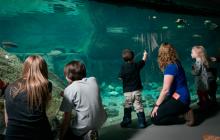


Walk through the Biodôme’s ice tunnel and travel from Montreal to Antarctica! In an instant, you arrive in an environment where animals have developed remarkable adaptations. Against a backdrop of snow-covered rocks, penguins can be seen speeding through the icy water.
The powerful sounds, marine scents, and cool air create a fully immersive sensory experience.
Five penguin species to observe
Although they may seem slow and awkward on land, penguins are remarkably agile in the water. Their streamlined bodies are so efficient that they can be compared to living torpedoes!
The highly active chinstrap penguins form a close-knit little group within our multi-species colony. Gentoo penguins, the most numerous, explore every corner of the habitat. Macaroni penguins and Moseley’s rockhopper penguin both sport yellow crests (tufts of feathers on the head), but their habits are quite different. While the former are calm and composed, the latter are agile and leap all over the steep cliffs.
The ledge on the left side of the habitat is perfectly suited to the King Penguins. Despite their imposing size, they can be quite clumsy on uneven ground!
Controlling day length for penguin well-being
Remarkably, the Biodôme’s subantarctic islands habitat faithfully recreates the daylight of that part of the world. Because these islands lie in the Southern Hemisphere, the seasons are the reverse of those in North America. As a result, the length of daylight ranges from 4 hours a day at the summer solstice in June to 20 hours of light in December.
This strong variation in photoperiod (the length of day and night), triggers breeding behaviour in penguins and supports their well-being. It is one of the reasons why Montréal’s Biodôme ranks among the best places in the world for keeping and breeding these species.
Penguins or auks? Penguins are flightless birds that live in the Southern Hemisphere. There are 18 species of them. Auks, by contrast, live in the Northern Hemisphere and can fly. They belong to the alcid family, which also includes puffins, murres, and guillemots. In French, the word pingouin refers to birds of the auk family, while manchot means “penguin.” The similarity between the words can cause confusion.
In nature
The subantarctic islands are isolated lands in the Southern Ocean, lying between the temperate latitudes of the Southern Hemisphere and the Antarctic continent. This climatic transition zone is characterized by low temperatures, strong winds, and high humidity.
The landscape is made up of mountains, often steep, rocky coastlines, and broad plains covered with mosses and grasses. Poor soils and the harsh climate limit plant diversity.
Large colonies of birds, including penguins, albatrosses, and petrels, as well as marine mammals, live on the subantarctic islands. They feed on fish and other organisms found in the cold, nutrient-rich waters.
A few facts and figures
Temperature: 2 to 5 degrees Celsius
Relative humidity: 60%
Total area: 175 square metres, with a pool holding 85,000 litres of water
Controlled lighting system: 4 hours of light per day in June; 20 hours per day in December