




- July 7, 2026 - Insectarium : Entomology news, Insect diversity
Ticks are becoming increasingly present in Quebec’s parks and green spaces. Learn how to easily identify them and find out what precautions to take so you can enjoy the outdoors safely.
The black-legged tick is the primary vector of Lyme disease
Ticks are small arthropods belonging to the class Arachnida. In Québec, the most closely monitored species is the black-legged tick, Ixodes scapularis, known for transmitting the Borrelia burgdorferi bacterium, the agent responsible for Lyme disease. Its small size and its resemblance to other arthropods mean that it can be confused with differing species, but careful observation will generally allow it to be identified.
Confusion between ticks and arthropods
Which arthropods are most often confused with ticks? The study entitled “I ‘Tick,’ Therefore I Am: Which Arthropods Are Misidentified as Ticks by the General Public?” led by André-Philippe Drapeau Picard, research officer at the Insectarium, in collaboration with Jérémie Bouffard and Jade Savage from Bishop’s University, focuses on this question.
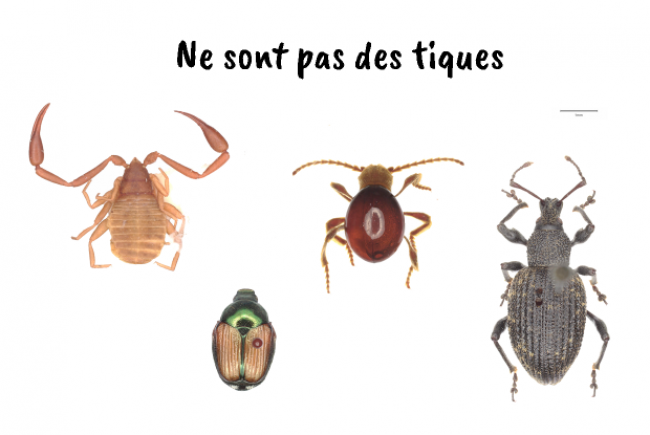
Using data derived from the community science program eTick, the entomologists identified a number of arthropods that the public frequently mistakes for ticks. Among the ones most often wrongly identified as ticks are spider beetles, weevils, Japanese beetles and pseudoscorpions.
These results underscore the importance of raising public awareness regarding the lesser-known arthropod species and of improving tick identification tools.
Characteristics for identifying a tick?
Depending on their stage of development, ticks measure between one and five mm (as small as a pencil tip or a poppy seed). Like most arachnids, they have eight legs in the nymphal and adult stage (but only six in the larval state), and their bodies are oval and flattened when unengorged. Unlike other arthropods, whose bodies are segmented into three parts (head, thorax, abdomen), ticks have fused bodies separated into a head and an abdomen. They have neither antennae nor wings.
Two ticks frequently encountered in Québec: the black-legged tick (Ixodes scapularis) and the American dog tick (Dermacentor variabilis).
Ticks grow active when temperatures climb above 4°C and snow is no longer covering the ground. They prefer damp environments and are generally encountered in forest undergrowth, in tall grass, in fallen leaves, and so on.
Preventing tick bites
To lessen the risk of being bitten, a number of preventative actions can be taken:
- Wear long clothing;
- Wear socks that reach over the hem of your pants;
- Use a repellant that contains DEET or icaridin;
- Stay on marked trails when walking in parks;
- Do a complete examination of your body once you’re back home;
- Put your clothes in the dryer.
Ticks and the One Health approach
Ticks are a good illustration of the One Health approach, which recognizes the close ties in human, animal and ecosystem health (Une Seule Santé cartoon). In peri-urban natural parks, a number of factors interact: environmental conditions, biodiversity, and interactions among species. Understanding these issues therefore requires the collaboration of numerous disciplines and stakeholders.
The PARCS en Santé (Healthy Parks) research project is a concrete example of that approach. The project is built around three main themes: ticks and their pathogens, white-tailed deer and the restoration of ecosystems, and community science, and brings to bear both scientific knowledge and the experience of communities. Carried out in several natural parks in the Montréal region, Montérégie and the Eastern Townships, its aim is to develop lasting strategies that make it possible to protect biodiversity while at the same time reducing the health risks connected to tick-transmitted illnesses. To that end, the project brings together specialists from a variety of domains (ecology, health, human and social sciences) and organizations from different sectors (environment, health) at different levels (municipal, provincial, federal). That integrated vision lies at the very heart of the One Health approach.
To learn more:
- TickTool platform
- eTick platform
- Monitoring in Québec (INSPQ)
Read also: