

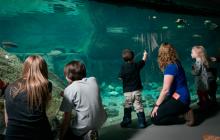


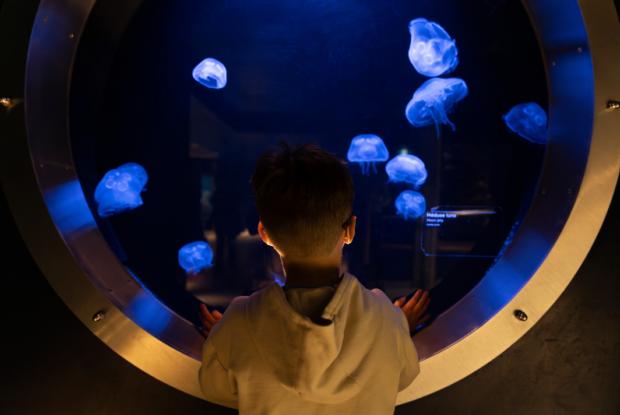


The Gulf of St. Lawrence and its coasts are home to remarkable plant and animal life. At the Biodôme, visitors explore this ecosystem from below the surface to the shore, beginning with an underwater view of fish in a marine tank and ending in a coastal landscape.
Fascinating marine life, from the depths to the shore
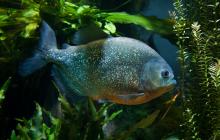
At the bottom of the large tank are flatfish such as the winter flounder and the thorny skate. On the rocks, spiny benthic fish and the ocean pout share the crevices with lobsters.
In the marine waters, Atlantic redfish, striped bass, and American shad swim alongside some of the Biodôme’s oldest residents, the Atlantic sturgeon.
Along the rocky shoreline, in shallower water, invertebrates are abundant: northern sea anemones, green sea urchins, and polar sea stars add their bright colours to the scene.
Marine habitats where plants and birds thrive
At the surface, beyond a coastal marsh, a landscape of shining willow and smooth rose comes into view. A coastal cliff rises as a natural barrier, lined with conifers and deciduous trees such as black spruce and speckled alder, creating a distinctly boreal landscape.
Along the shore, shorebirds and sea ducks, including common eiders, Harlequin ducks, and scoters, catch the eye. Freeze-thaw action has carved crevices where Jack pines, bearberries, and common junipers take root. In this environment, which may seem inhospitable, the vegetation is adapted to the nature of the substrate: a rocky, shallow, and often nutrient-poor soil. Some plants that grow at the meeting point of marine and terrestrial environments can also be found here, such as lyme grass.
Overhead, black-legged kittiwakes and common terns wheel and call, as if we were standing on the shores of the St. Lawrence. From the top of the walkway and the mezzanine, through the branches of white birch and tamarack, the view of this striking landscape is even more impressive.
In nature
The Gulf of St. Lawrence forms a vast gateway between the Atlantic and the continent. It is a network of islands, cliffs, bays, and deep basins. Here, the freshwater of the river meets the saltwater of the ocean, creating a unique environment where surface currents mingle with the cold waters of the depths.
It is home to a mosaic of natural systems: salt marshes, coastal forests, rocky shorelines, sandy beaches, submarine plains, and deep canyons. Each offers its own conditions for life, sustained by their interconnections. Nutrients deposited by the tides in a marsh nourish life in nearby bays, and the biodiversity protected by the coast, in turn, supports wildlife farther out at sea.
A few facts and figures
Summer temperature: 18 to 24 degrees Celsius (April 1 to September 30)
Winter temperature: 4 to 12 degrees Celsius (November 1 to February 28)
Relative humidity: 30% in winter to 70% in summer
Total area: 1,620 square metres (tank containing 2.5 million litres of salt water)
Controlled lighting system: Follows the daylight cycle observed at the latitudes of the Gulf of St. Lawrence