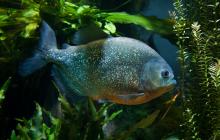
During the breeding season, males display brighter colours. The red on the head and gill covers intensifies, forming a clear visual signal that attracts females. Courtship includes fin movements, circling, and characteristic “dances” that precede mating.
When the female is ready to spawn, the pair carefully cleans a flat area of sand or gravel. The female lays her eggs there, sometimes as many as 300, and the male fertilizes them immediately. Depending on the water temperature, the eggs remain exposed at the site for 24 to 72 hours.
Mouthbrooding
As soon as the eggs hatch, the parents take the larvae into their mouths, where they continue to develop. This mouthbrooding protects the fry from predators and provides a stable environment during the early stages of development.
Over the following days, the parents dig small hollows in the sand where the fry can take shelter. At the first sign of danger, the young are immediately taken back into the parents’ mouths and released again once the threat has passed or when the adults move to a new spot.
After about 10 days of mouthbrooding, the young reach the free-swimming stage and begin feeding on small invertebrates. Their growth is relatively slow, and it often takes up to three years for them to reach adult size.